

A high voltage transmission line project is not managed by treating towers individually, but by controlling progression along a constrained alignment.
Challenging access conditions, environmental restrictions, regulatory requirements, and mobile crews:
sequencing directly impacts continuity and overall performance.
A high voltage line project is characterized by:
an extended and sometimes discontinuous linear alignment
complex or remote access conditions
significant environmental and regulatory constraints
successive technical phases (foundations, tower erection, stringing)
coordination of multiple mobile teams
Planning must reflect not only what is built, but also where work takes place, under which access conditions, and within which regulatory framework.
On a transmission line project, a delay in a sensitive zone can affect the entire alignment.
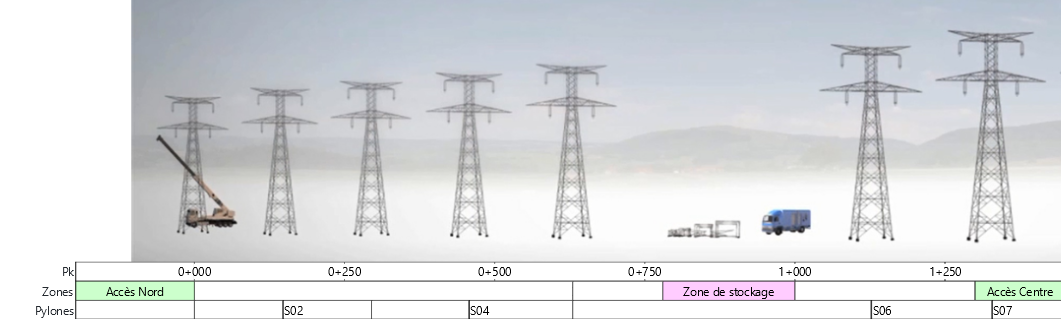
A purely time-based schedule:
hides distances between work sections
does not clearly represent access constraints
separates technical phases from the real alignment
makes environmental restrictions difficult to anticipate
Result:
The schedule becomes difficult to use for coordinating mobile teams and securing critical phases.
What is not spatially visible in the schedule often turns into logistical delays on site.
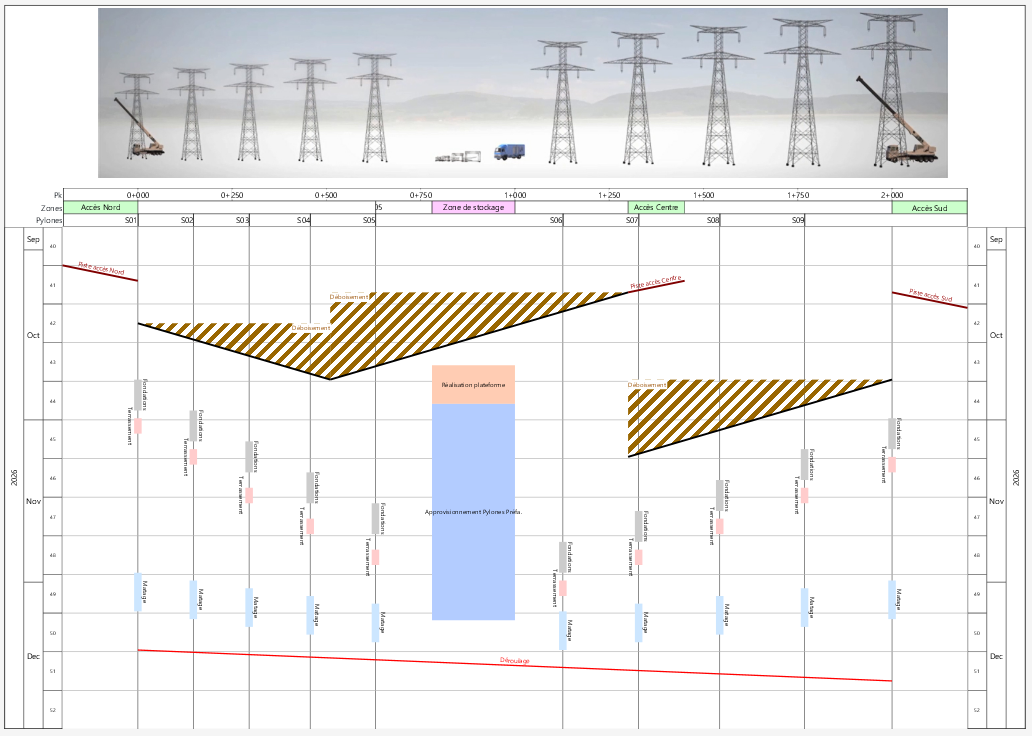
With TILOS 360, the transmission line project is planned:
along the actual route of the line
by integrating access zones and work areas
sequencing by tower or by section
incorporating environmental and regulatory constraints
and coordinating interactions between mobile crews
Each activity is positioned simultaneously:
in time
in physical space along the alignment
and in relation to other interventions
The schedule becomes an operational coordination tool across the entire route.